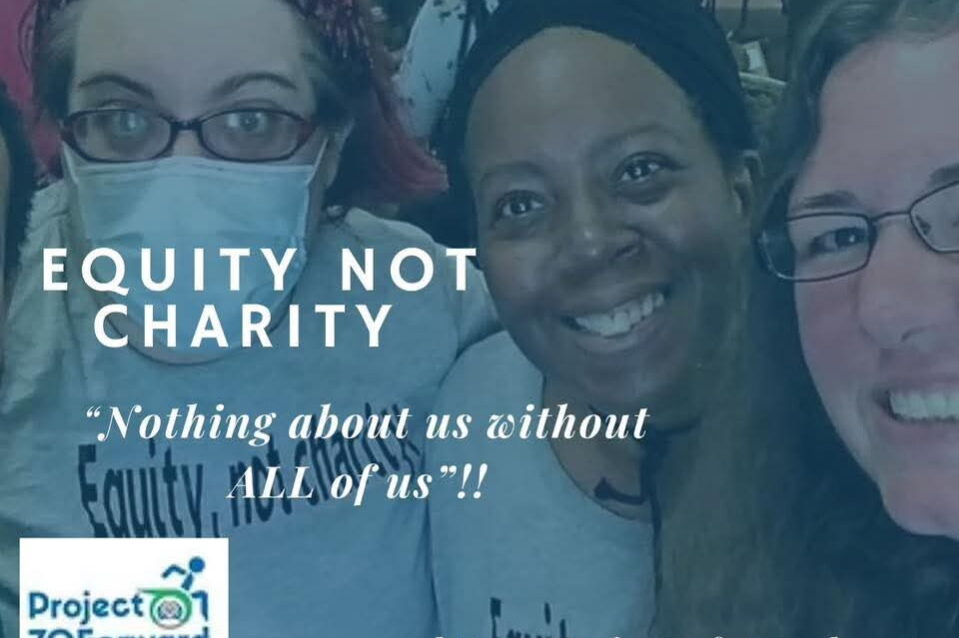
For decades, the disability rights movement has rallied behind the powerful chant: “Nothing About Us Without Us.” Those words have carried demands into policy hearings, protests, and global advocacy. We told the world that disabled people must be present in decisions that shape our lives. The chant is not just a slogan — it’s a declaration of self-determination, dignity, and justice. Those words have echoed in the U.S. and across the globe. We told the world that disabled people must be at the table… in every decision that shapes our lives.
But today, I say it differently:
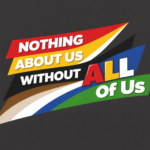
“Nothing About Us Without All of Us.”
At first, you may think I simply added one word. But that word — all — transforms the meaning of this statement in a profound way.
Why the Upgrade Matters
The original chant made sure some disabled voices were included. But over time, we’ve also seen how certain voices within our own community were still left behind. Disabled people who are Black, brown, queer, undocumented, unhoused, incarcerated, or with multiple marginalizations and intersections often don’t see themselves centered in the policies, campaigns, or even the disability spaces that claim to represent all of us.
“Nothing About Us Without Us” demanded inclusion — but sometimes it stopped short of full intersectionality. By including ONE words, this upgrade makes that expectation clear: no part of our community should ever be forgotten, ignored, or tokenized.
Who Gets Left Out When We Don’t Say All
- Race & Disability: Black disabled people face higher rates of police violence, unemployment, and health disparities — yet their stories are often sidelined in mainstream disability narratives. Just do a Google search and you have to add the descriptor “African-American” or “Black” to include multi-ethnic images. Conditions are still separated and white images are still prioritized.
- Gender & Disability: Disabled women and non-binary people experience higher rates of abuse and poverty, but their leadership in shaping solutions is under-recognized. While I encourage spaces that uplift gender diversity, it should not be because their voices are quenched in established disability hubs, support groups and resources.
- Neurodivergent & Intellectual Disabilities: Too often, those with intellectual disabilities are excluded from decision-making spaces, even within disability organizations.
- LGBTQ+ Disabled People: Queer and trans disabled voices are erased in both LGBTQ+ and disability communities, treated as if they don’t exist or matter.
When we say “Nothing About Us Without All of Us,” we are naming and rejecting those exclusions. For those with multiple intersections, it is time to make sure our rallying cry includes so many who have been left out.
From Awareness to Belonging
Adding all is a call to move from awareness to belonging. Awareness simply says, “I see you.” Belonging says, “You are part of this family, and your voice, your culture, your struggles, and your victories matter here.”
Disability justice already teaches us this: no one is left behind. My shift in the chant allows us to bring forth this alignment. It is no longer assumed. It is very clear what we mean.
The Power of Language in Our Movement
Chants, slogans, and language are more than words. They are cultural markers of our values. By expanding the chant, we’re expanding our movement’s commitment. We’re setting a higher bar; not just inclusion, but equity. Not just presence, but power and real people.
A Call Forward
So the next time you’re at a rally, a meeting, or a community event, I invite you to join me in saying:
“Nothing About Us Without All of Us.”
Because our liberation is not complete until every disabled person — across race, gender, class, sexuality, and ability — is part of the decision-making, the leadership, and the vision of the future.
When we add all, we remind the world: true justice is never partial.
Punchy Quotes I will be using from now on:
- “Nothing About Us Without Us is good, but Nothing About Us Without ALL of Us is justice.”
- “No part of our community can ever be left behind. Not one voice. Not one life.”
- “Our fight is not just for inclusion. It’s for equity, belonging, and power.”
- “Until ALL of us are free, none of us are truly free.”
Judith Wilson Brown
https://jwbadvocates.com